Celestron - PowerSeeker 127EQ Telescope - Manual German Equatorial Mount - Telescopes for Adults - Compact and Portable - BONUS Astronomy Software Package – 127mm Aperture
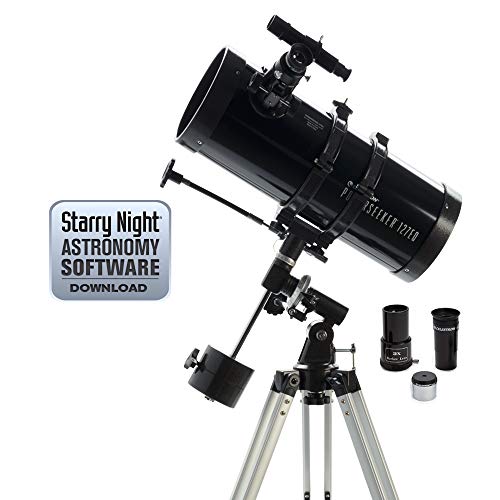
- PERFECT BEGINNERS TELESCOPE: The Celestron PowerSeeker 127EQ is an easy-to-use and powerful telescope. The PowerSeeker series is designed to give the first-time telescope user the perfect combination of quality, value, features, and power.
- MANUAL GERMAN EQUATORIAL MOUNT: Celestron telescopes for adults feature a sturdy mount with large slow-motion control knobs so you can track objects smoothly as they move across the night sky.
- COMPACT AND PORTABLE: The PowerSeeker series is compact, lightweight, and portable. Take the telescope to your favorite campsite or dark sky observing site, or simply the backyard.
- MULTIPLE ACCESSORIES: The Celestron PowerSeeker 127EQ Telescope comes with two eyepieces (20mm and 4mm), plus a 3x Barlow lens to triple the power of each. Users can also download BONUS Starry Night Astronomy Software Package.
- UNBEATABLE WARRANTY AND CUSTOMER SUPPORT: Buy with confidence from the world’s #1 telescope brand, based in California since 1960. You’ll also receive a 2-year warranty and unlimited access to technical support from our team of US-based experts.


Lisa Laws Peaks
Excellent for Amateur Astronomy
This is my first telescope since the POS telescopes from childhood. I’ve had this for about 2 months and have really enjoyed it. I can clearly see Saturn’s rings, divisions and moons. Jupiter’s cloud banding is just out of reach but is definitely inferred. Venus and Mars are mostly featureless but show as crescents due to positioning. The moon shows excellent detail on mountains and craters, particularly near the day/night border. The visual quality is very good. Place a pea on the counterand and set your eye about a foot away. That is a good approximation of the relative size of Jupiter on the max included lense combo. Collimation. Buy this for $30 and use it. SVBONY Red Laser Collimator 1.25'' Simple, quick, effective, easy and sharp picture. I removed the finder scope as it was more trouble than it was worth. I replaced it with a cheap red dot optic that I had lying around and it is a major improvement. I’m still learning and haven’t quite gotten out of the solar system yet, but for the price (~$100 on open box deal) I am well pleased. The kids think Saturn is the neatest.
John Banks
Superb Optics out of the Box ! Nice Solid Equatorial Mount.
This is a review specifically for the Celestron PS 114mm EQ. I got this as a gift from my daughter. After using it a few nights, I did check the mirror collimation with the $28 Celestron 1.25" collimation eyepiece (which I already had). The mirror alignment was very very close, so it needed only minimal adjustment which had no observable effects. On the third night I was able to see the moon (again) and the Orion nebula at various magnification (20mm eyepiece with and without Barlow). I was also able to see - with a Celestron Ploessel 9mm eyepiece - Jupiter and it four moons, the two main cloud stripes on Jupiter itself, and maybe some weaker ones. And the shadow of one moon on Jupiter itself, a tiny black dot near one of the poles. I do like the lightweight aluminum mount as well, it is solid if the legs are not completely extended, and it is light enough to carry around without getting a hernia. The finder scope works well for me, just in case I re-align it every time I take the telescope out. This telescope is very sharp, and a very good value right out of the box. And easy to focus. Five stars!! EDIT: Recently (February) I did buy and install the Celestron motor drive ($33 on Amazon) and it works perfectly. Once the motor drive speed is adjusted properly with the small knob (which is fairly easy to do), it keeps say Jupiter centered for close to an hour with a 7mm eyepiece. Note that the drive speed only needs to be set once, for a given latitude. Note that the Celestron 127EQ and 114EQ are quite similar in design and price, nevertheless this one has a much longer tube and does not have a correcting eyepiece in the focus tube, which seems to make it significantly sharper, or at least much easier to collimate. Recently (April) I got an inexpensive laser collimator (lk1 from seben dot com, identical to the orion lasermate) and tried it on this scope, even though it did not seem to need it. The whole job is very easy, takes less than 5-10 mins if you know what to do (there is no focuser lens in the focusing tube, this is NOT a Bird-Jones design!). The adjustments were minimal and there was no noticeable change in sharpness, as I said above mine was flawless out of the box. Look in the picture section to see my recent picture of Jupiter. Best additions to this telescope are imo the $30 Celestron motor drive (I love it!), a better quality achromatic $40 Celestron 2x Omni Barlow, and a 9mm Celestron Omni eyepiece($20 ; the telescope seems capable of a lot more than what the rather basic included eyepieces suggest). You will then be in telescope heaven, for very little money. I have also found that this scope is quite well suited to astrophotography of the planets, in my case in combination with the very reliable Celestron clock drive (have not changed a battery yet on that on in three months of use) and an inexpensive webcam (a logitech C310 in my case). PS. Added pictures of Jupiter and the Moon (April 2014). Added more pictures of Jupiter and Mars, on the latter I can clearly see one of the polar ice caps (April 2014). Took a nice picture of the Cassini division on Saturn (May 2014). Added another excellent picture I got of Jupiter on a very clear day (March 2015), you can clearly see multiple rings as well as details of the main ring clouds.
Cassy Heichel
Powerful scope at a modest price. Love it.
Very well made telescope that exceeds the asking price in materials and construction alone. Out of the box and assembled we were able to zero in Mars. It was impressive. We are satisfied customers. It was nice to find one in this price range not geared toward young children. We live in central Arizona and have perfect evenings for star gazing either in the desert or from a mountain top location. NOT for the impatient or for those seeking instant gratification. This is in essence a scientific instrument and you will have a learning curve if a beginner (in fact you may find Newtonian scopes the most frustrating tool ever encountered if a novice. Be patient and give yourself time. Research the operation of this device. Read the literature supplied, look at the discs supplied, watch you-tube videos of it's use. Don't dis this fine product because you can't figure out how to use it, or you are not willing to learn.)
Jeffrey Nii Armah Adamah
This is a great telescope for the price
This is a great telescope for the price, you probably won't find much better than this. First off, I would recommend losing the finder scope that comes with this, and get a red dot finder, you will save yourself much frustration. I picked up a Gosky red dot finder for pretty cheap and aligned it with the telescope pretty easily and it works so much better. I also picked up a collimation eyepiece as well to help out with getting this properly collimated, it took a little bit of patience but after doing so it made a drastic difference in focus and clarity. Most importantly, be patient and take the time to learn how to use it if you have never used an EQ mount before. I had not, but I took the time to watch videos and read instructions before the telescope got here and it helped drastically. Still took some time to get familiar with it but once you've got it figured out it is quite simple to use. Take the time to figure out how to properly balance with the counterweight as well, and you will save yourself much headache. That is a very important step and you will be frustrated if you do not properly balance it first. The mount is a bit shaky when using the higher power lenses, but after all this is not a super expensive telescope. If that is important to you, I would recommend forking over more money to get either a power drive for your mount, or just buying a more expensive mount that will probably be significantly more expensive. I am very much an amateur at this and don't use it every day, so this setup is perfect for me without having to spend too much money on a highly expensive setup. I was able to see the moon quite easily, I usually start out the evening by finding the moon first and focusing in on it to get things situated and lined up, then move on to other points in sky. I was able to see Jupiter and its moons quite clearly, as well as Saturn and was able to make out the rings which was breathtaking. For something like that, make sure you get familiar with using the knobs to make small adjustments, keep in mind all points in the sky are constantly moving from our point of view, so as soon as you are centered and focused on something you will have to continually adjust to keep up with the moving object in sky. Overall, I have had a blast with this telescope and would very highly recommend it for the price. If you are not a novice at this, you will probably want to buy something more expensive, but for me this was absolutely perfect and I love it!
Brea Alyse
Great Scope!!!
This scope catches a lot of flack in the forums and here. Let me demystify some of the bad reviews. 1) Collimation This telescope can be collimated easily by eye, if you want to collimate with a laser, you'll have to remove the corrective lens in the focuser tube. If you love to tinker knock yourself out however, this isn't the most powerful scope you can buy so, eye collimation is more than enough to be happy. 2) The finder scope is unusable While I agree, it's not the best finder scope out there and lining it up with the telescope can take a long time but, it is possible with time and patients. It's also replaceable so if you don't like it, get another one. (note: it is a scope and not a finder, the image is reversed in the finder) 3) I can't see anything out of this thing You need to collimate the scope and line up the finder scope, the instructions are in the manual for eye collimation (tip: back the focuser tube all the way out when you collimate, doing this will let you see both the secondary mirror and the primary, also note, this went through shipping and if it arrived with all the mirrors aligned and ready to go, get a power ball ticket because you'd be the luckiest person on the planet 4) The Barlow is useless Please google and youtube what a barlow is and how to use them, it's not a true lens and once you find out its true purpose, it'll make more sense 5) The 4mm lens is useless See my comment on the barlow, using the barlow with the 4mm will tame things a bit, also, get a lens and filter kit with a 15mm and a 9mm lens. 6) The Telescope doesn't stay put on the tripod. The counterweight on this telescope is not for looks, you need to use it to balance the telescope on the eq mount. when the counter weight is properly balanced, you can put the telescope in any position on the right ascension axis and it'll stay put. The Telescope itself also has to be balanced front to back in the mounting hoops (youtube it, there are a billion tutorials on how to do this.) One last comment on this issue is, do not try to push the telescope into position with the clutches locked, use the controls on the tripod to position the scope, if you need to make big adjustments, loosen the clutches (should be OK because your telescope is balanced) position the scope to the general area of viewing, lock the clutches and use the controls to fine tune. If you push the scope around with the clutches locked you're manhandling the gears that the controls are attached to and you can push them out of whack, don't do this. Here's the deal, this is a marvelous telescope for UNDER 200 American green backs!!! When properly set up, balanced and overall ready to view, it's a great scope and it's a lot of fun. Buying upgrades for the scope will add to your viewing pleasure. Yes you can see our planetary neighbors, the moon looks fantastic, in a dark place, you can see some deeper space stuff. Is this a good scope for beginners? Yes I think it is, backyard astronomy is not a plug and play out of the box and looking at Jupiter kind of deal. A telescope is a pretty sensitive thing that takes a little love. If you're just starting out and collimation, calibration and generic tinkering is not your thing, this may not be your hobby, heck aside from sitting on the couch, I don't know what hobby doesn't require a little hands on setup and tinkering. Finding stuff in the sky is hard, small movements at the scope have a huge impact on where you're looking in the sky, youtube is your friend, so is google.
Kathy Cole Carrington Thomason
great value
This little telescope is really nice for the price. Smooth and works well. I did have one problem with the adjustment cables and a quick email to the company and they sent me two sets (4) replacement cables! This thing is great if you take the time to set it up correctly. The moon looks amazing and even with the eyepieces that come with it, you can see Saturn and rings in a clear night. Worth it to get some other intermediary eye pieces. Update: I contacted Celestron about the cables, and within a week or so they sent me 2 more sets of adjustment cables for free. The telescope is back in action and last night, I caught a very clear view of Saturn, rings and all. It was incredible!
Artika Lata
Excellent telescope for both the casual viewer and the backyard astronomer.
I am a retired astronomy teacher. I taught on high school and college levels, using a planetarium at the college where I worked, with no problem. I have a simple Edmund Scientific Astroscan telescope because it is very easy to set up and use, although it is limited in its scope. I am a theoretical person who can talk easily of special relativity or stellar evolution with ease, but ask me to do anything with my hands and it's chaos. I am terrible with mechanical reasoning, so setting this telescope up and calibrating and balancing it took some time and patience on my part. However, once I figured it all out, well, WOW. Comparing my new Celestron to the durable and loyal Astroscan is kind of like comparing driving a Porsche with driving a VW beetle. I love the Celestron but I'll suggest something to those thinking of buying this telescope. Trust me, also buy the set of lenses and filters for this telescope that are sold separately because the power of these lenses is infinitely better than the two lenses that come with the telescope (one is too weak, the other so strong that the field becomes so limited that you'll drive yourself crazy trying to find your object again. Other than that, I am extremely satisfied with this telescope. I may eventually upgrade even further, but for now, I'm happy as a bug in a rug (as my Irish dad used to say). The filters work great for showing details on the planets that I'd never been able to see with my small telescope before, and as Jupiter and Saturn are up right now along with, of course, the moon in its cycle, I'm getting lots of great things to look at. I'm really looking forward to when Mars is back in good position, as the filter for Mars should enable me to see polar ice caps and other surface details that I've never been able to pick out before. I'm also looking forward to the late fall/winter sky with the Orion nebula, the Pleiades and the Andromeda galaxy in full glory. I've seen them with the Astroscan; I can't wait to see them with the Celestron's lenses and filters to help the details emerge. I am one happy backyard astronomer who misses teaching classes but can at least keep up with a love of the skies that began many decades ago when my dad first showed me the Big and Little Dippers and other such wonders from our front porch when I was a little girl. I'm very happy and proud of myself that I was able to conquer my fear of mechanical issues and figured out the telescope without having to call the techs. Believe me, if I can do it, you can! Go for it; you won't be sorry.
Sandy Stripling-Groves
Great scope for learning astronomy basics!
This is a really great telescope for someone who wants to try their hand at astronomy without breaking the bank. It definitely isn't the best scope, but it's a great bargain for what you get. Scope: Overall a nice 5" scope. I have yet to find a place dark enough to fully exploit all the things that can be seen with this scope. You can easily see Saturn, Jupiter, the Pleiades, many different galaxies and nebulae, and some fun double stars. I'm still a newbie myself, but I have a blast using this. One note: due to the design of the scope, if you want to use a laser collimator to help align the mirrors you will need to remove the corrector lens at the base of the focuser. There's a youtube video that walks you through it. Mount: Pretty sturdy equatorial mount. Haven't fully exploited everything you can do with it yet. I will say that you should look up how to use an equatorial mount online as I was using it as an alt-azimuth mount and almost damaged it. It's not super steady, so I don't think it would work well for any astrophotography. But it's easy to adjust and very simple to travel with. Tripod: Probably the weakest part of this kit. While it's light and works decently enough, it's wobbly. As a result, you have to be vary careful not to touch the scope while observing. Eyepieces: I've greatly enjoyed the basic 20mm eyepiece that came with the kit. It gives a good view for most objects and provides a baseline for learning to use the scope. The 4mm isn't much good in all but the brightest conditions, so I have used it much. The barlow works decently well with the 20mm for getting a nice, close view of planets. It's too magnified for any galaxies or nebula though. Finderscope: It works if you can get it aligned, which I couldn't. As a result I replaced it with Celestron's red dot finder and haven't had a complaint since. Overall, if you want to get started in stargazing this is a great scope. It has a learning curve, but it will teach you all the basics while being powerful enough to keep you interested for a long time. It has its faults, but it's only $130 bucks. For that price, it's an excellent scope that will provide hours of wonder. One aside: this might not be a good kid-friendly scope. I would recommend a refractor scope as those are much simpler and harder to damage.
Bonnie Crossman
REACH FOR THE STARS!!
I have no comparison for this other than the more simplistic Refractor Telescope my father got me as a kid...so now the circle continues, as I got this for my own son. This is the type I always dreamed of getting as a kid, but back then these were in the $500 range and easily too much for my parents growing up. The price point on this for what it offers is awesome, and I selected this after about 6-8 hours of reviewing specs, feedback, and much contemplation. It was this or the 114mm longer tube version, and I opted for this in the end (I figured this had a little more power and it looked more portable than the longer tube of the 114, since we have to go somewhere to view the sky due to the forested yard we have). We have taken it out twice now, & I was NOT disappointed, HOWEVER, a few pointers will definitely help if you're thinking of getting this, to give you the best success chance possible: 1) What i read about was VERY true--buy a telecope for the tube itself, NOT the eyepieces it comes with. After MUCH searching I decided upon a zoomable eyepiece to buy along with this: http://www.amazon.com/Celestron-93230-24mm-1-25-Eyepiece/dp/B0007UQNV8 I figured this would be a nice way to avoid having to replace eyepieces (it comes with a 20mm and 4mm, and comparing those to this zoomable one is night 7 day difference...the quality and the versatility of the zoomable blows the stock ones out of the water). Its especially nice to start in the 24mm (24x) place, align everything, find your target & focus, then zoom in on it (even with the barlow for additional zooming power), refocus slightly and then enjoy the sight! We successfully located and watched both mars & saturn on our first 2 attempts (using only the free google skymap app for Android to help us locate the planets). What they say about the rings of saturn are so true...you will never forget the first time you see them. It IS a bit small, but you can make them out if everything is in focus and you dont touch the the telescope once everything is in view (until the planet moves out of the field of view, in which case the fine-tune movements of the telescope really shines!). All in all, buy this telescope NOT for the eyepieces, but for the tube itself, which is one of the bets values from everything I have seen. If you pair it with any non-stock eyepiece you will not be disappointed! If you choose not to go with this zoomable one I mention here (that the only additional thing I got for this when I first bought it), even though the price is very reasonable currently @ $51, I'd recommend the 9mm one from Celestron (currently about $20). The stock 20mm eyepiece is "ok" but the stock 4mm I found utterly useless. At least the 9mm aftermarket eyepiece gives you about a 2X zoom vs. the stock 20mm. And then you have to decide if the stock 3X barlow (see next) is worth using at all either. 2) BARLOW. Had no idea what this was before I bought this or started researching info about telescopes. Basically its a zooming piece for your normal eyepieces. The stock version that comes with this is "ok" but I dont have anything (yet) to compare it against. Lets just say it "works" to some extent, but all the reviews I read about said this one sucked...to go after an aftermarket 2x or 3x. From all the reviews and research I've gathered, and now using the stock version, I'd say I'd have to agree in all likelihood. Due to this, and since my son seems to have really enjoyed our first 2 outings, I decided to take the next step & get a combo 2x barlow that also serves as a T-adapter to allow for photography! At only $45, that seems like a really good deal, especially since the 3X barlow I found from Celestron was around $80. The 2x combo can be found here: http://www.amazon.com/Celestron-Adapter-Barlow-Universal-T-Ring/dp/B00009X3UV I can't say for sure how this will be, but I can tell you it certainly cant be worse than the stock 3x, which seemed very cheaply made (again you buy the telescope for the mirror & tube). Paired with the zoomable aftermarket 8-24mm eyepiece mentioned above and I think itll be a slam dunk. Plus it allows for adapting for use with a digital camera (well possibly non-digital as well, but we have a sony DSLR that should work with the T-adapter for the model we have, which was only about $10...for $55 I get an aftermarket 2x barlow that adapts to allow a DSLR...pretty decent!). 3) Other accessories: I have not chosen to get any more than I have listed here, but there was 1 have to mention that I may have to invest in at a later time. One of the concerns about the Newtonian scopes (this is one) was the possibility of having to correct/adjust the mirrors. I chose not to buy the collimator (adjusting tool) out of the box, but was prepared to buy either the cheaper $20 one or possibly the more expensive but from all I can see, more worth it, laser-optics one for about $70. Thankfully it seems my scope did not need it out of the box, but I suspect the lower star reviews that say it didnt work out of the box either had the rare scope that needed it from the get-go, or else the more likely scenario, is that the patience needed to align the finder mini-scope on top of the tube, with the eyepiece view (using the 20mm or in my case, the much better zoomable 8-24x eyepiece, which allows for a much wider field of view than even the 20mm stock) was probably the major factor in most of the low reviews. Having done my research I knew it would require patience when using (see more on that below) and it paid off hugely when you have a 6 yr old and an 8yr old wildly ecstatic with waiting a half-hour to get Saturn's rings into view...see below for details). 3) With the accessories out of the way, lets talk about SETUP & USE. First, for setup, I was very meticulous about it and very careful, but from opening the box to final setup & cleanup, I was done in an hour. NO TOOLS were required. Just a touch of patience and carefulness. Seemed very reasonable to me. 4) USE: as I mentioned we have taken this out on 2 outings already (have had it less than a week) and both times were widly successful. I have to say that its really useful to have google's free skymap with you when you use this, or even another product I got from Amazon, called Stellarium. Both are good apps and do things a little differently. Together they made finding the planets a breeze and helped us find, focus, and enjoy the views VERY quickly. Both mars & Saturn were easily found using the apps, mars being the easier one to figure out even without the app, due to its orange-tinge color. First, we aligned the mini-scope on top (finder scope) using a distant cell tower as a target (rem the images are UPSIDE DOWN, which when viewing stellar objects is not a big deal). Once we had this aligned (took about 5-10 mins) we located mars, and due to the patience of doing the finder scope, we saw mars in the unzoomed 24x eyepiece ON THE FIRST TRY. So do not skip this step if you can! Now, when we first viewed mars it was a huge fuzzy, hazy blob, with the crosshairs intersected it (in the eyepiece, not the finder scope). I knew we had to focus. So in less than 30 seconds we had it focused and viola! The orange "star" (aka, mars) was seen! The kids were ecstatic! But i told them this was just the beginning :). I zoomed in with the zoomable eyepiece and we could actually make out the slightly crescent shape of mars. But the real goal was saturn's rings! One of the kids had to use the restroom but they said they'd hold it till we saw saturn. I was up against the clock now. but in my 30 mins of use thus far I knew we could do this! In less than 5 minutes later I had saturn in view at low power with rings clearly visible! Kids were in awe (as was i!) and we even tried the 3x barlow (stock). For this, i found that zooming in past about halfway was not very useful. the image was a bit fuzzy. the 3x barlow at 20-24x was good though. I later discovered that this was probably the upper end of the scope's ability to magnify, roughly 250-300X maximum without image distortion/loss. Thus, going back to the barlow section eariler, is why I think a 2X barlow will be great, using the maximum zoom of the eyepiece (8mm). FURTHER THOUGHTS: I hope you have enjoyed my "journey" described here and maybe help someone else decide if this telescope or Astronomy endeavor is worth it and which one to go after. The more expensive motorized ones are probably worth it if you are really into Astronomy, but I could nto afford them (they start around $300 for 114mm scopes, which is pretty reasonable), or the $250+ Dobsonians (non motorized but even more powerful than this one) are a good option too. But i suspect with the low-cost additions I already have ordered noted above, this scope will do just find for now. Plus they have an motorized addition for this thats only around $35, but it does not auto-track. If you align everything properly reviews have said it does help a lot. Thats something else I may invest in down the line. All in all, for under $200 starting, I got this scope & the aftermarket zoomable eyepiece which I almost call a must. For around another $50 you can get an aftermarket barlow that even opens up some astrophotography (but I am sure thats going to take a lot of patience to be successful from what i have read). Good luck and REACH FOR THE STARS! :)
Kyle Harris
Really Incredible Value For Money. Literally anyone can afford this little gem! Love it. And love the company that makes it!
This is an amazing little introductory scope. It's amazingly easy to use, reasonably transportable and best of all totally backed by an awesome support organization from a simply wonderful company! I haven't had a telescope in decades, but when my daughter bought this for me I had it set up, configured and was looking at the Orion Nebula in about 1 hour. It's definitely powerful enough for casual users, but amazingly inexpensive. A few weeks after I first used it, one of our dogs ran through the room where I keep it and managed to knock it over. The mount broke (no other damage to this reasonably sturdy little guy!) I called the company, told them I'd be happy to buy the parts to fix it...they sent a whole new mount at no charge! Awesome support!